
The name, and the land.
The practice carries a Mi'kmaq word for its name. There is a place behind that choice, and a responsibility — and both are held here, in the open, rather than smoothed over.
Where the name comes from.
Genesa grew up on the island of Newfoundland — Ktaqmkuk — a northern place where winter was never a metaphor. It had to be braved: gathered for, waited through, moved through with intention. It was also a place where the Indigenous peoples who had stewarded that land since long before her family arrived were not, in the world she was raised in, revered or even respected.
Apipunsit — a Mi'kmaq word, to spend winter — is named into both of those truths at once. It is homage to the Mi'kmaq, whose understanding of winter as a season to move through rather than be defeated by is the understanding this whole practice is built on.
And it is a reckoning: that understanding, and the people who carried it, went unhonoured on the very ground that taught it. To name the work in their language is to carry forward, deliberately and out loud, what should have been honoured all along — winter as the Mi'kmaq understood it, as it shaped the woman who grew up there, and as it shapes this sector now.
"I was raised on their land, in a place that had to brave winter to survive it. Naming my work in their language is one way to honour what was not honoured there."
Apipunsit.
A Mi'kmaq word: to spend winter.
It was chosen because it carries, in a single word, the whole way this practice sees the work.
Winter is the season the practice was built for.
The long, hard stretch when resources are thin, the light is short, and the temptation is to read the difficulty as failure. Apipunsit refuses that reading.
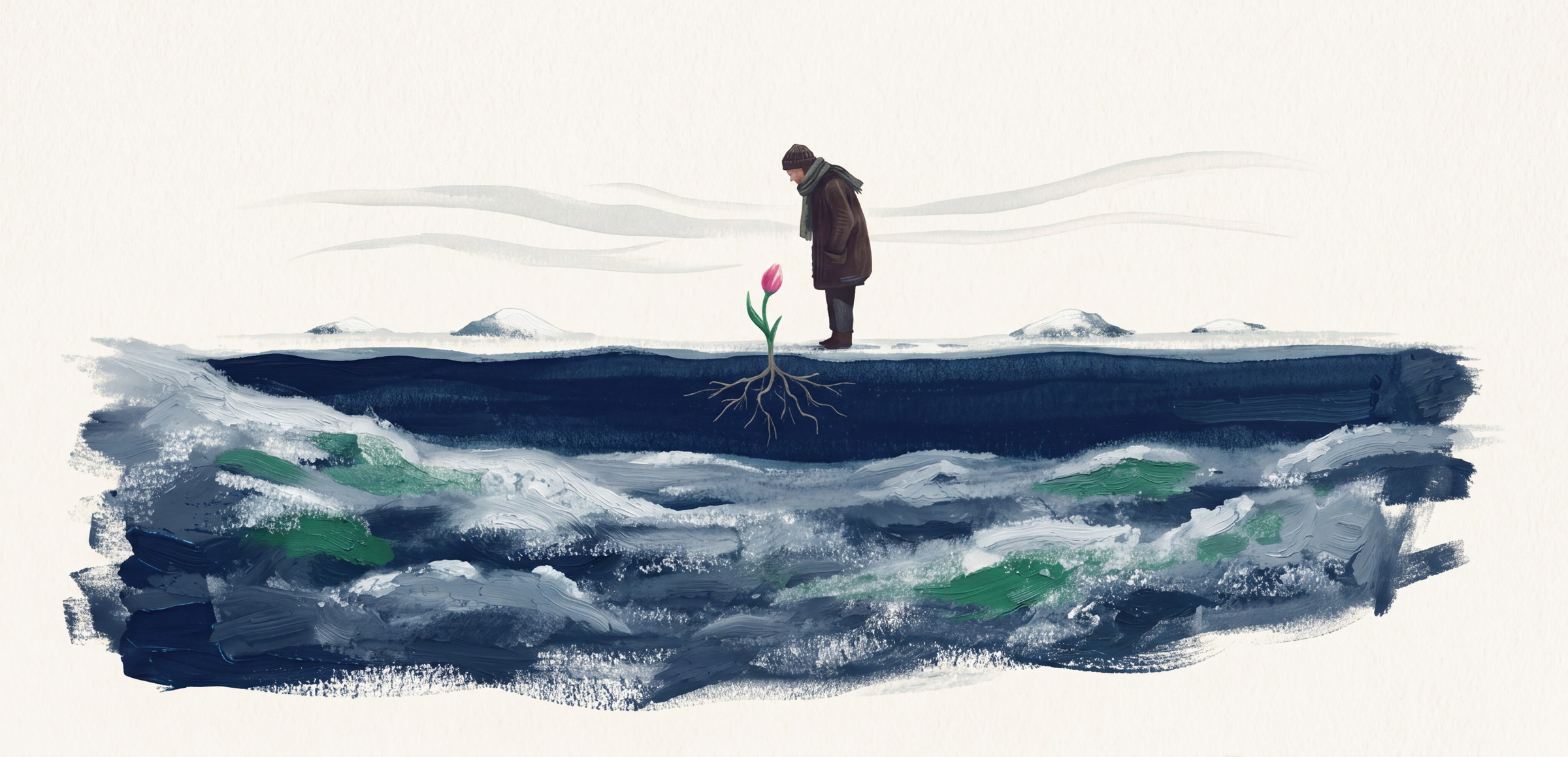
To spend winter is not to be defeated by it; it is to move through it with intention — to gather, to root, to wait well, and to prepare for what grows next. Winter is not the end of the story. It is the season that shapes it.
A verb, not a noun.
In Mi'kmaq, that is less the exception than the rule. It is a polysynthetic, verb-based language: where English reaches for nouns, Mi'kmaq builds verbs — even colours and states are things something does. The work, then, is named for an action, not a thing.
To spend winter is something you do — to gather, to conserve, to wait well, to prepare. Even the rest at its centre is active: not stopping, but the patient work of holding steady so that what comes next can grow.
That is the posture of the whole practice. Naming the season, finding the decisions, staying alongside — none of it is something you possess; all of it is something you do.
Held with care, and in relationship.
Apipunsit is named in a language that is not its founder's to claim lightly. The name is offered as homage, not ownership — and homage to a living people is fuller when it is made with them, not only about them.
In carrying this name, Genesa has begun reaching out to Mi'kmaw leadership and community voices in Newfoundland — not to seek permission for a finished thing, but to say why, to listen, and to ask what she should understand and honour in carrying it. The hope is that the homage lives as a relationship, not a gesture made at a distance.
Naming the practice in Mi'kmaq is meant to live as ongoing practice, not formality — and to deepen, not conclude.
Two homelands, coast to coast.
Genesa grew up on the island of Newfoundland — Ktaqmkuk — part of Mi'kma'ki, the ancestral and unceded territory of the Mi'kmaq, the land that gives this practice its name. The island was first home to the Beothuk, its original people, who — dispossessed of the coast they relied on, and through starvation, introduced disease, and violence in the wake of European settlement — were destroyed as a people; Shanawdithit, the last known Beothuk, died in 1829. Their memory is held here, not passed over. We acknowledge the Mi'kmaq as ancestral and continuing stewards of Ktaqmkuk, and acknowledge with respect the Mi'kmaw, Innu, and Inuit peoples of Newfoundland and Labrador. The territory is covered by the Treaties of Peace and Friendship, which did not surrender land or title, but set out an ongoing relationship between nations.
Apipunsit works from Vancouver, on the traditional, ancestral, and unceded territories of the xʷməθkʷəy̓əm (Musqueam), Sḵwx̱wú7mesh (Squamish), and səlilwətaɬ (Tsleil-Waututh) Nations — Coast Salish peoples who have stewarded these lands and waters since time immemorial. From this base, the practice works with organizations across Canada.
To carry a Mi'kmaq name, and to do the work on Coast Salish land, is to carry a responsibility: to honour these places and peoples, and to keep learning — a responsibility still being grown into, not one ever completed. We let acknowledgment live as practice rather than formality, held in humility and meant to be deepened in relationship.
Saying the words.
These are approximations, offered with respect — Mi'kmaq and Coast Salish sounds don't map neatly onto English, and they are best heard from fluent speakers and each nation's own recordings. A starting point, not the last word:
- Apipunsit — a-pee-PUN-sit — to spend winter, the verb the practice is named for
- Mi'kmaq / Mi'kmaw — MIG-maw — the people / the adjective form
- Mi'kma'ki — MEEG-ma-gee — the Mi'kmaq homeland
- Ktaqmkuk — g'TAHM-gook — the island of Newfoundland, "land across the water"
- Beothuk — bee-OTH-uk — the original people of the island of Newfoundland
- Shanawdithit — shuh-NAW-di-thit — the last known Beothuk, died 1829
- xʷməθkʷəy̓əm (Musqueam) — MUS-kwee-um — host nation, Vancouver
- Sḵwx̱wú7mesh (Squamish) — SKWAW-mish — host nation, Vancouver
- səlilwətaɬ (Tsleil-Waututh) — sleil-WAH-tooth — host nation, Vancouver
From the name, everything else follows — the seasons, the belief that organizations are buried rather than broken, the navy that stands for winter, and the two sharp accents of colour set against it: pink for the bravery a hard season asks, green for the growth that comes through.